Chula Satit students Win Gold Medal and Special Award at CSITF International Innovation Expo
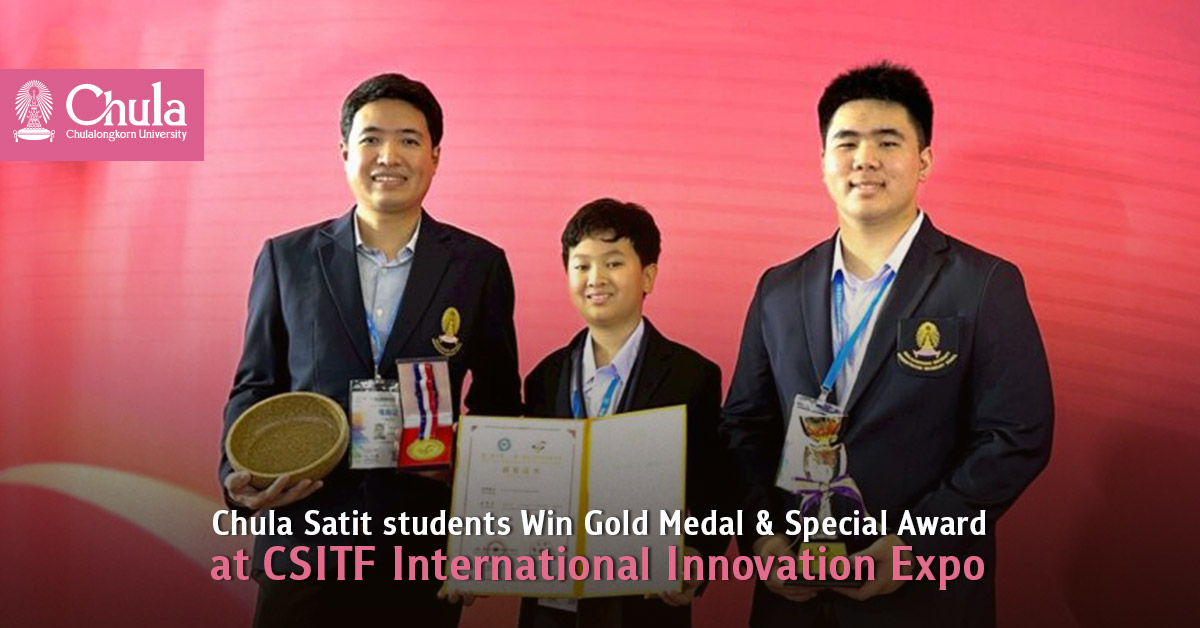
A big round of applause for young innovators from Chulalongkorn University Demonstration School (Chula Satit), who won a gold medal at “The 8th China (Shanghai) International Invention & Innovation Expo 2025 (CSITF),” held from June 10-14, 2025, in Shanghai, People’s Republic of China. Their project, “BERD – Bio-Eco Rock Development from natural waste materials,” also earned them a special award presented by Ms. Supamas Isaraphakdee, Minister of Higher Education, Science, Research and Innovation (MHESI), and Dr. Wiparat De-ong, Executive Director of the National Research Council of Thailand (NRCT).


The award-winning team includes Mr. Thipok Tangsiriphat, a student in Grade 11/3; Master Pattharaphon Vanichwattana, a student in Grade 7/1, and Miss Alisa Traiwittayakorn (a student from another school) under the supervision of Ajarn Komed Najang, with support from co-advisors Ajarn Jeerasak Jitrojanarak and Asst. Prof. Dr. Anyaporn Boonmahitthisud.
Chula Satit was invited to participate in this global innovation competition by the National Research Council of Thailand, following their triumph at the Thailand New Gen Inventors Award 2025 (I-New Gen Award 2025).

BERD is an innovative green synthetic composite material developed using synthetic stone production technology. It adds value to natural agricultural waste such as coffee bean pulp, used tea leaves, rice husks, macadamia nut shells, and wood chips as fillers. This results in a lightweight, durable product with a distinctive and aesthetically pleasing pattern. Designed for practical use, BERD can be molded into a variety of products suited for eco-friendly home décor and sustainable green building applications. It boasts excellent mechanical and chemical properties, including fire resistance, making it a promising material in both design and environmental sectors.

Therefore, BERD has the potential to generate additional income for farmers, reduce greenhouse gas emissions from agroindustry and agricultural waste, preserve natural resources, and prevent the loss of biodiversity. It exemplifies how sustainable innovation can drive real-world impact.